My Child Needs Speech Therapy. Does It Have to Be in Our Language?
Margaret Stoch ·
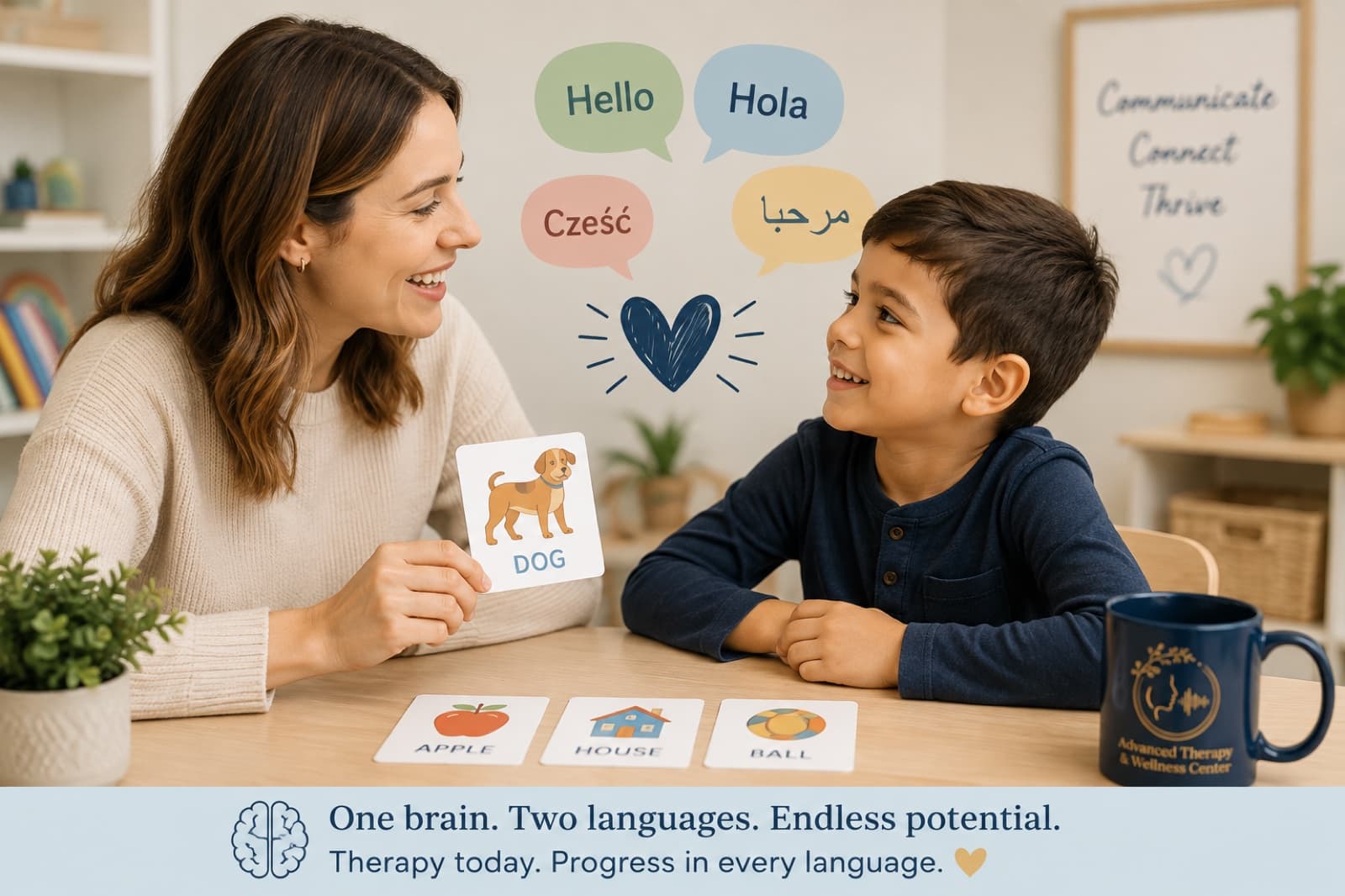
If your family speaks Polish, Spanish, Arabic, or any other language at home, and your child was just diagnosed with a speech or language disorder, you're probably wrestling with the same questions we hear from parents every week at our Crest Hill clinic.
Will therapy in English even work? Should we hold out for a therapist who speaks our language, even if the wait is long? Did raising our child with two languages cause this?
I understand these questions on a personal level. I came to this country from Poland at sixteen, and I've spent my career as a speech-language pathologist working with families who love their language and worry it's somehow in the way. So let me give you the answers the research supports — because they're probably not what you've been told.
The disorder is in the child, not in the language
A speech or language disorder isn't attached to English, or to Polish, or to any particular language. It reflects how a child's brain processes and produces language itself. That's why a child with a true disorder shows difficulty in every language they speak. A child who leaves out grammar endings in English leaves them out in Spanish too. A child who can't produce certain sounds struggles with those sounds in both languages.
This matters for a practical reason: since the problem lives in the underlying language system, that system is what a good therapist treats. The language used in the session is the tool, not the target.
Two languages did not cause this
This myth refuses to die, so let's be direct. Bilingual children develop speech and language disorders at exactly the same rate as children who speak one language. Decades of research have found no link between growing up with two languages and having a language delay or disorder — and that holds true even for children with autism or Down syndrome.
Nothing you did by speaking your language at home caused your child's difficulty. And switching your home to English-only won't fix it.
What your child learns in therapy transfers between languages
Here's the part most parents haven't heard. When researchers study bilingual children in speech therapy, they keep finding the same thing: progress made in one language shows up in the other.
A 2023 systematic review of language intervention studies in bilingual children with developmental language disorder found that vocabulary and grammar gains made in one language transferred to the second language. Studies of speech sound disorders show the same pattern. In one, two Spanish-English bilingual children received therapy entirely in Spanish — and their English speech improved just as much as their Spanish, even though English was never targeted in a single session.
The reason is simple. Your child doesn't have an English brain and a Polish brain. There's one language system in there, and the two languages share sounds, rules, and structures. Strengthen the system, and both languages benefit.
The real risk isn't English. It's waiting.
Many families are told, or decide on their own, to hold out for a therapist who speaks their home language. I understand the instinct. But bilingual speech-language pathologists are in short supply across the country, and waitlists for them can run months or longer.
Here's what the research says about that trade-off. Early treatment changes outcomes. In one study of toddlers with language delay, only 5% of children who received early intervention still showed a delay at age 3 — compared to 85% of children who didn't get help. Speech sound problems that persist past school entry raise a child's risk of reading difficulty, and children with untreated communication problems report more trouble with peers. The window before kindergarten matters most, and it doesn't stay open while a family sits on a waitlist.
Put those facts together and the conclusion is hard to avoid: starting therapy now, in English, will do far more for your child than waiting a year for therapy in your language. The skills transfer. The lost time doesn't come back.
Your language is part of the treatment plan
None of this means your language gets left out. The opposite. You are the home-language half of the team — and honestly, you're better at that half than any therapist could be.
Keep talking, reading, singing, and telling stories in the language that feels natural to you. Children need rich, fluent, loving language input, and they get the best of that when parents speak the language they know deepest. Ask your therapist what your child is working on, then practice it at home in your words. The skill is the same whether the sentence is in English or Spanish.
What we ask families not to do: don't switch to English at home because you think it will help therapy along. Research shows it doesn't, and it can shrink the amount and quality of language your child hears each day. It can also cost your child something harder to measure — the connection to grandparents, cousins, and culture that comes only through your language.
Questions we hear from parents
Will therapy in English confuse my child? No. Bilingual children manage two languages all day, every day. Research shows they benefit from instruction in either language, and gains carry across. "Confusion" between languages is not a real phenomenon in bilingual development.
My child mixes both languages in one sentence. Is that a sign of the disorder? No — that's called code-mixing, and it's completely normal bilingual behavior. Healthy bilingual adults do it too. It shows your child is using everything they've got to communicate, which is exactly what we want.
Wouldn't a therapist who speaks our language still be better? If one is available without a long wait, bilingual therapy is a great option. But when the choice is English therapy now versus home-language therapy after months on a waitlist, the evidence points firmly to starting now. Your child gets the trained-therapist half in English and the home-language half from you.
Should we speak only English at home so our child hears more of it? Please don't. Your child will get plenty of English from school, therapy, and community. What only you can provide is fluent, natural, emotionally rich language — and for most families, that's the home language. Speak the language you speak best.
The bottom line
A speech or language disorder shows up in every language your child speaks, which means good therapy helps every language your child speaks. The language of the session matters far less than getting the session. Start therapy as soon as you can, in the language available to you, and keep your home language alive at home.
That's what the research supports, and it's what we recommend for every bilingual family we serve.
Concerned about your child's speech or language? Don't wait for answers. Contact us to schedule an evaluation, or call us at (815) 782-4196. Advanced Therapy & Wellness Center · 16009 Executive Dr, Crest Hill, IL 60403.
Sources available on request — this post is based on peer-reviewed research including Nair et al. (2023), International Journal of Language & Communication Disorders; Guiberson & Ferris (2019), American Journal of Speech-Language Pathology; Holm & Dodd (2001), Folia Phoniatrica et Logopaedica; and Ward (1999), International Journal of Language & Communication Disorders.