Pediatric Language Therapy
Pediatric language therapy helps children who struggle to understand language or express themselves: late talkers, kids with limited vocabulary or short sentences, and children who have trouble following directions or telling you what happened. Advanced Therapy & Wellness Center provides one-on-one language therapy in Crest Hill, Illinois, including AAC support for children who need another way to communicate.
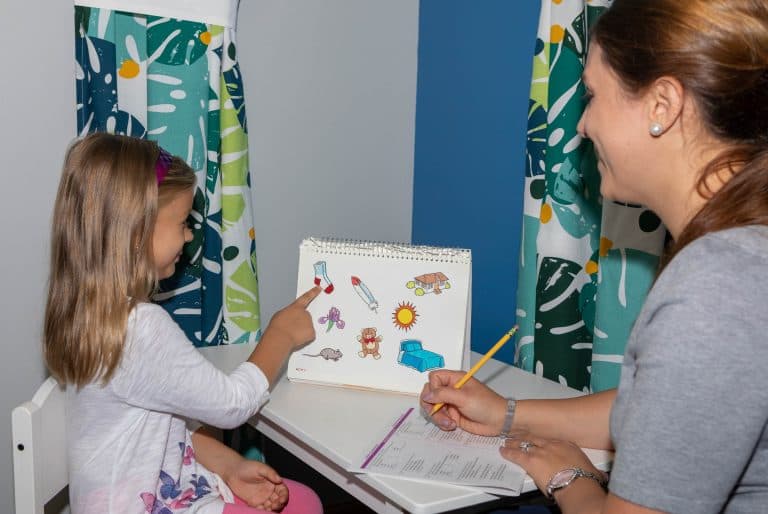
Speech is how words sound. Language is having the words at all, and knowing how to put them together, understand them, and use them with people. A child can pronounce everything beautifully and still be struggling with language, and the other way around.
Language grows fastest in the early years, which is why "wait and see" is the most expensive advice a family can get. If your gut says your child should be saying more by now, that instinct deserves an evaluation, not another six months of waiting.
And for children who need a different route to communication, we support AAC, augmentative and alternative communication, from picture systems to speech-generating devices. Every child deserves a way to be heard while spoken language grows.
Signs your child may benefit from language therapy
- Few or no words by 18 months, or no two-word phrases by age 2
- A vocabulary that feels small next to same-age peers
- Trouble following directions, especially two-step ones
- Short, jumbled, or grammatically off sentences past the expected age
- Difficulty answering questions or retelling what just happened
- Frustration, tantrums, or giving up when trying to communicate
- Relying on pointing, pulling, or a sibling who "translates"
- Losing words or skills the child used to have
Who it helps
We work with toddlers through school-age children: late talkers around 18 months to 3 years, preschoolers whose language isn't keeping up, school-age kids with developmental language disorder or comprehension gaps, and children of any age who need AAC to communicate. Many of our language patients also work on feeding or speech sounds, and one clinician covers it in one plan.
What language therapy looks like at ATWC
Evaluation separates what your child understands (receptive language) from what they can express (expressive language), using standardized measures plus real play and real conversation. You leave knowing exactly where the gaps are, in plain words.
Therapy is one-on-one and built on play, books, and the things your child already loves, because children learn language inside relationships, not flashcard drills. You get specific strategies to fold into daily routines: how to narrate, how to pause, how to turn everyday moments into language practice.
When a child needs AAC, we choose and program the system with the family, teach everyone around the child to model it, and keep building spoken language alongside it. AAC doesn't slow talking down; used well, it speeds it up, and we'll show you the how and why.
Frequently asked questions
What is the difference between speech therapy and language therapy?
Speech therapy targets how words sound, including articulation and clarity, while language therapy targets vocabulary, sentence-building, comprehension, and using language socially. Many children need one, some need both, and the evaluation tells us which.
My toddler isn't talking yet. When should I be concerned?
General guideposts: first words around 12 months, at least 50 words and two-word phrases by age 2. If your child is behind those marks, an evaluation is worthwhile now, because late talkers who need help benefit most from starting early.
Will my child just catch up on their own?
Some late talkers do catch up, but research can't reliably predict which ones, and the ones who don't lose precious months of the fastest language-learning window. An evaluation gives you a real answer instead of a coin flip.
What is AAC, and will it stop my child from talking?
AAC (augmentative and alternative communication) includes picture boards and speech-generating devices that give a child a way to communicate now. Research consistently shows AAC supports spoken language development rather than replacing it, and we build speech alongside it.
What is developmental language disorder?
Developmental language disorder (DLD) is a common, lifelong difficulty learning and using language that isn't explained by hearing loss or another condition, affecting roughly two children in every classroom. Therapy meaningfully improves communication, academics, and confidence.
Is pediatric language therapy covered by insurance?
ATWC is in-network with BCBS PPO, and superbills are provided for out-of-network plans, which often reimburse language therapy. Call 815-782-4196 and we'll help you verify your benefits.

