Myofunctional Therapy
Orofacial myofunctional therapy retrains the muscles of the face, mouth, and tongue to rest and work the way they're supposed to: lips closed, tongue on the palate, breathing through the nose. Advanced Therapy & Wellness Center provides myofunctional therapy for children and adults at our clinic in Crest Hill, Illinois, serving families across Joliet, Plainfield, and the southwest Chicago suburbs.
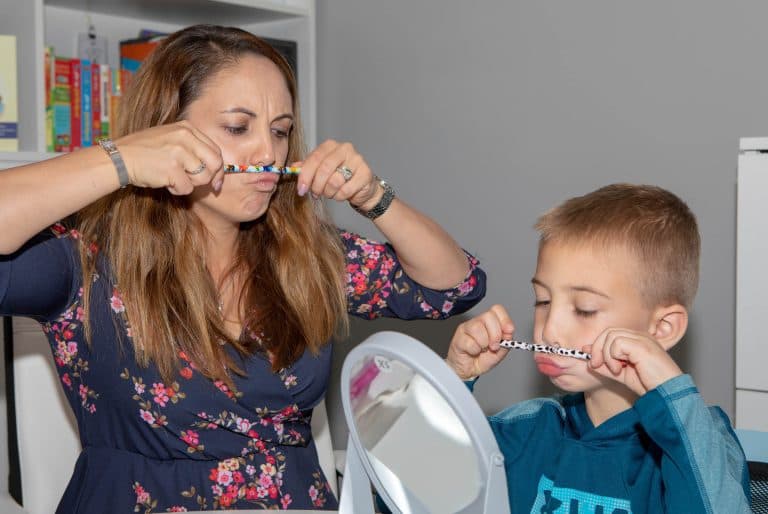
Most people have never heard of myofunctional therapy until a dentist, orthodontist, or sleep specialist says the words "tongue posture" out loud. But the way your tongue rests and the way you breathe shape a surprising amount: sleep, chewing, swallowing, jaw growth in kids, even behavior and school performance.
These patterns are easiest to correct early in life. They can absolutely be corrected in adults too. Either way, the muscles can be retrained, and that's exactly what we do.
Signs of a myofunctional disorder
- Mouth breathing, during the day or at night
- Open mouth posture at rest
- Tongue thrust (the tongue pushes forward when swallowing or speaking)
- Tongue visible at rest, while eating, or during speech
- Crowded teeth, narrow palate, or small jaws
- Thumb or finger sucking, prolonged pacifier or bottle use, mouthing non-food items
- Jaw clicking or jaw pain (TMD)
- Snoring or restless sleep
- Speech or swallowing difficulties that haven't resolved with traditional therapy
Who it helps
We treat children (typically age 4 and up for a full myofunctional program), teens, and adults. Younger children with oral habits or feeding concerns start with a modified, play-based approach. Many of our adult patients come to us through their dentist or orthodontist, often before or during orthodontic treatment, or after years of unexplained jaw tension, poor sleep, or relapsed orthodontics.
What an evaluation looks like at ATWC
Your first visit is a full orofacial myofunctional evaluation. We look at how the tongue, lips, cheeks, and jaw rest and move, how you breathe, how you swallow, and how all of it fits with your history, because a mouth breather at age 35 usually has a story that starts in childhood. We take that history seriously and we listen to your instincts.
Treatment is a structured exercise program that retrains resting posture, chewing, and swallowing, paired with habit elimination where it's needed. Sessions are one-on-one, and you get specific daily exercises between visits. Progress is measurable: we're watching for nasal breathing, lips together at rest, and a correct swallow, not just "doing the exercises."
When your case involves other providers, an airway-centric dentist, an orthodontist, an ENT, we collaborate directly with them. That team approach is how myofunctional work actually sticks.
What if normal isn't?
Not sure where to start? Score your airway.
The free Airway Score takes a few minutes and tells you whether mouth breathing, snoring, or oral habits deserve a closer look, for you or your child. It's the easiest first step, and it costs nothing.
Get Your Free Airway ScoreFrequently asked questions
What is orofacial myofunctional therapy?
Orofacial myofunctional therapy is a structured exercise-based program that retrains the muscles of the mouth and face to rest and function correctly, with the tongue on the palate, lips closed, and breathing through the nose. It is used to treat tongue thrust, mouth breathing, open mouth posture, and related oral habits.
How do I know if my child needs myofunctional therapy?
Common signs that a child may benefit from a myofunctional evaluation include mouth breathing, an open mouth at rest, snoring, a tongue that pushes forward during swallowing or speech, crowded teeth, and prolonged thumb sucking or pacifier use. An evaluation at Advanced Therapy & Wellness Center can determine whether a myofunctional disorder is present.
Can adults do myofunctional therapy, or is it just for kids?
Adults benefit from myofunctional therapy too. Adult patients often seek treatment for jaw pain, snoring, orthodontic relapse, or long-standing mouth breathing, and the muscle retraining works at any age.
How long does myofunctional therapy take?
A typical myofunctional therapy program runs several months, with regular sessions and short daily exercises at home. The exact length depends on the disorder, the patient's age, and how consistently the home program is practiced.
Does myofunctional therapy help with sleep and snoring?
Myofunctional therapy addresses several of the muscle patterns associated with snoring and disrupted sleep, including open mouth posture and low tongue resting position. Many patients pursue it alongside care from a sleep physician, dentist, or ENT, and we coordinate with those providers directly.
Is myofunctional therapy covered by insurance?
Advanced Therapy & Wellness Center is in-network with BCBS PPO, and many other plans reimburse through out-of-network benefits using the superbill we provide. Call us at 815-782-4196 and we'll help you check.
Do I need a referral to start?
No referral is needed to schedule a myofunctional evaluation, although many patients are referred by dentists, orthodontists, and ENTs. If another provider referred you, bring their notes and we'll build on them.

