Occupational Therapy
Occupational therapy helps children build the physical, sensory, and self-regulation skills they need for everyday life: play, handwriting, coordination, focus, and independence. Advanced Therapy & Wellness Center provides pediatric occupational therapy in Crest Hill, Illinois, with a focus on the "why" behind each functional challenge.

OT looks at the whole child: strength, reflexes, sensory processing, and the nervous system underneath it all. When a child struggles with handwriting or meltdowns or clumsiness, our job isn't to drill the surface skill. It's to find out why the skill is hard and treat that.
That's also why OT here moves more than motor skills. A regulated nervous system has an easier time learning anything new, and we see that show up in speech, language, and social skills as much as in handwriting. Because our OT and speech-language therapists work from one integrated plan, that carryover is built in.
Our OT program includes an individualized plan that can include specialties such as gentle, hands-on bodywork and craniosacral fascial therapy, reflex integration for retained primitive reflexes, and everyday skill building for activities of daily living. Explore each below, or start here with general OT.
Signs a child may benefit from OT
- Trouble with handwriting, scissors, buttons, or utensils
- Clumsiness, weak core, or avoiding physical play
- Big reactions to sounds, textures, tags, or transitions
- Difficulty calming down, sitting for a meal, or shifting between activities
- Struggles with social and play skills alongside motor difficulties
- In infants: head-turning preference, flat spots, or tummy-time hatred
Who it helps
We treat infants through school-age children, including kids with ADHD, autism, Down syndrome, learning disabilities, genetic conditions, sensory processing disorders, and behavioral concerns.
What OT looks like at ATWC
Evaluation looks past the surface skill to the systems underneath: primitive reflexes, sensory processing, strength, fine motor, visual motor, and regulation. We share what we find and set goals that matter at your kitchen table, not just on a clipboard.
Sessions are play-based and one-on-one. Parents get honest coaching and home strategies that fit real family schedules, using the natural opportunities already in your day.
Because our OT works alongside speech and feeding therapists, kids who need more than one discipline get one coordinated plan under one roof. The regulation work in OT often makes speech and language sessions more productive, too, and social skills grow right alongside.
What we work on
Open any card to see why it matters and what treatment looks like.

General OT skills
Daily-living skills, fine motor control, and hand-eye coordination, taught through purposeful play.
General OT skills
Daily-living skills, fine motor control, and hand-eye coordination, taught through purposeful play.
Why it matters
Buttons, utensils, scissors, and zippers are how a child earns independence, and every one of them is built on hand strength, coordination, and motor planning. When those foundations are weak, the child isn't being lazy or careless; the task genuinely costs them more effort than it costs their peers.
What it looks like
Sessions look like play and are engineered down to the grip: therapist-chosen games, crafts, and obstacle work that load exactly the muscles and patterns your child needs. You get simple carryover activities that slot into normal family life, not a second homework load.
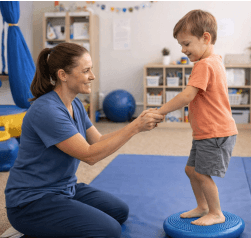
Sensory-motor integration
Helping the nervous system take in sensory information and answer with organized movement.
Sensory-motor integration
Helping the nervous system take in sensory information and answer with organized movement.
Why it matters
A child who melts down over tags, covers their ears in the gym, or crashes into everything isn't misbehaving; their nervous system is mis-reading the volume of the world. Until the sensory system is regulated, behavior plans and academics fight an uphill battle.
What it looks like
We map your child's sensory profile, then use swings, textures, movement, and individualized sensory work to teach the nervous system better answers. Parents get ideas and plans for integrating different activities and strategies into the activities they are already doing for the most ease of carryover.
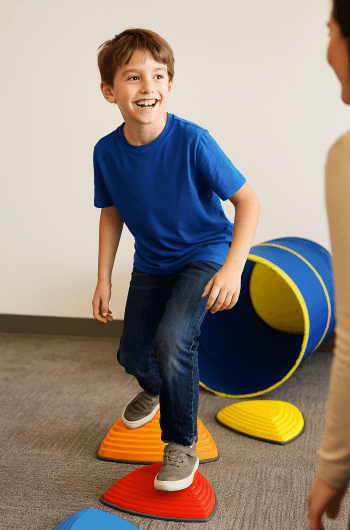
Gross motor strength & coordination
Core strength, balance, bilateral coordination, and motor planning: the foundation under playground skills and classroom stamina.
Gross motor strength & coordination
Core strength, balance, bilateral coordination, and motor planning: the foundation under playground skills and classroom stamina.
Why it matters
The child who slumps at their desk, W-sits, or avoids the monkey bars is usually running on a weak core, and a weak core taxes everything above it, including attention and handwriting. Strength here pays out everywhere.
What it looks like
Obstacle courses, climbing, animal walks, exercises, and other whole-body movements and activities, adjusted so your child can become stronger, more confident, and build more endurance without noticing they're even working.

Visual-motor & visual-perceptual skills
The eye-hand teamwork behind handwriting, copying from the board, puzzles, and catching a ball.
Visual-motor & visual-perceptual skills
The eye-hand teamwork behind handwriting, copying from the board, puzzles, and catching a ball.
Why it matters
A child can have perfect vision and still struggle to make their eyes and hands cooperate, which shows up as laborious handwriting, lost places while reading, and frustration with puzzles and sports. It's a trainable skill set, not a character flaw.
What it looks like
Through hands-on work, movement, and purposeful activities, we support the postural foundations, eye-hand coordination, and visual processing needed to locate items, recognize forms, understand spatial relationships, and copy or organize information during play, handwriting, and everyday tasks.

Autonomic nervous system regulation
Teaching a child's body to move between alert and calm, because self-regulation is a skill, not a character trait.
Autonomic nervous system regulation
Teaching a child's body to move between alert and calm, because self-regulation is a skill, not a character trait.
Why it matters
A nervous system stuck in fight-or-flight can't learn, sleep well, or sit through dinner, and no sticker chart changes that. Regulation has to be built bottom-up, through the body. And once it is, everything gets easier to learn: kids we see for regulation often make faster progress in speech, language, and social skills, because the body finally lets the brain do its job.
What it looks like
Breathing games, movement routines, heavy work, and co-regulation strategies parents learn alongside the child. The goal is a kid who can feel themselves revving up and knows what to do about it.
OT specialty programs
Bodywork & Craniosacral Fascial Therapy
Gentle, hands-on care for infants, children, teens, and adults: CFT, torticollis, TummyTime Method, and TMJ tension.
Explore →Reflex Integration
Movement-based therapy for retained primitive reflexes that interfere with focus, coordination, and posture.
Explore →Adult Pelvic Floor Therapy
Occupational therapy for women with bladder, bowel, pelvic comfort, and coordination concerns, including pregnancy and postpartum.
Explore →Frequently asked questions
What does a pediatric occupational therapist actually do?
A pediatric occupational therapist helps children build the skills daily life requires, including fine motor control, coordination, sensory processing, and self-regulation. At ATWC, therapy targets the underlying reason a skill is hard, not just the skill itself.
My child hates tummy time or has a head-turning preference. Is that OT?
Yes, that's our bodywork program: gentle, OT-led treatment for infant tension, torticollis, and tummy-time struggles. See the Bodywork & Craniosacral Fascial Therapy page for what those sessions look like.
What are retained primitive reflexes?
Primitive reflexes are automatic movement patterns babies are born with that normally fade in the first year of life; when they persist, they can interfere with coordination, posture, and attention. ATWC has a dedicated reflex integration program for exactly this.
Does my child need OT, speech therapy, or both?
The honest answer is that it depends on the evaluation, because motor, sensory, speech, and feeding challenges frequently overlap. Since ATWC provides both disciplines in one clinic, we can evaluate across them and build one coordinated plan.
How long are sessions and how often?
Sessions typically run 45 to 60 minutes, once or twice weekly depending on the plan, with short home carryover activities between visits. We reassess progress with you on a regular schedule.
Is occupational therapy covered by insurance?
ATWC is in-network with BCBS PPO, and superbills are provided for out-of-network reimbursement. Call 815-782-4196 and we'll help you verify what your plan covers.
Related at ATWC
 Clare Travers