Pediatric Speech Therapy
Pediatric speech therapy evaluates and treats how a child speaks, understands language, and eats: articulation errors, phonological processes, language delay, apraxia, dysarthria, and feeding difficulties including extreme picky eating. Advanced Therapy & Wellness Center provides one-on-one pediatric speech therapy in Crest Hill, Illinois, serving families throughout Joliet, Plainfield, and the surrounding suburbs.
You know your child. If something about their speech, their understanding, or their eating feels behind, that instinct is worth an evaluation, not a year of "wait and see." Early intervention consistently produces better outcomes, and skills build on skills.
We work closely with you, your child's teachers, other therapists, and doctors so treatment fits your child's actual life, not a generic protocol. And because ATWC clinicians are also trained in myofunctional and feeding therapy, we catch the structural stuff, mouth breathing, tongue posture, restricted tongues, that a standard speech evaluation can miss.
Signs your child may benefit from speech therapy
- Speech that's hard for strangers (or you) to understand
- Specific sounds that won't come in: r, s, l, th, k, and friends
- Fewer words than peers, or trouble putting words together
- Difficulty following directions or answering questions
- Frustration, meltdowns, or withdrawal around communication
- Suspected or diagnosed childhood apraxia of speech or dysarthria
- A very limited diet, gagging on textures, or mealtime battles ("picky eating" that's beyond picky)
- Drooling, mouth breathing, or messy chewing past the expected age
Who it helps
We treat toddlers through teens: late talkers around 18 months to 2 years, preschoolers with unclear speech, school-age kids with stubborn articulation errors or language gaps, and children of any age with feeding difficulties.
What treatment looks like at ATWC
Evaluation first. We take an in-depth history, because whether the concern came from a doctor or a moms' group, your observations are data. Then we assess speech sounds, language, oral structures, and feeding as needed, and we explain what we found in plain words.
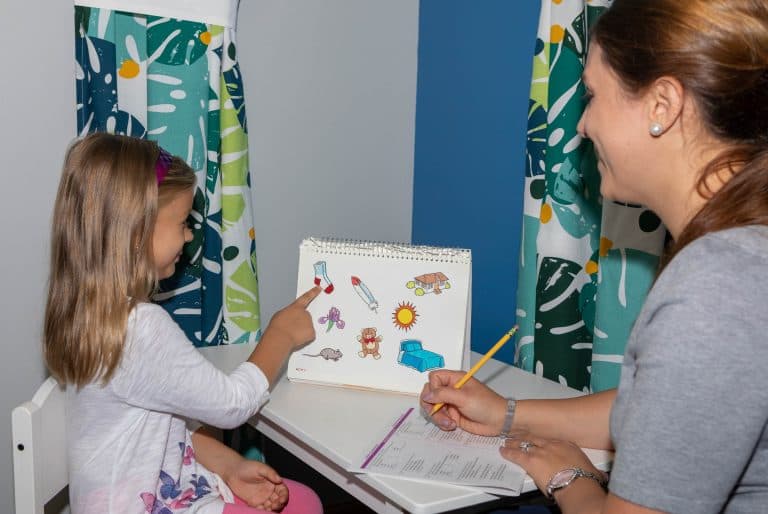
Therapy is one-on-one and looks a lot like play, because that's how kids learn. Underneath the play is a specific plan with measurable goals, and you'll always know what we're working on and how to practice it at home in a few minutes a day.
If we spot signs that something structural is in the way, a tethered oral tissue, an airway issue, a myofunctional pattern, we address it or bring in the right collaborator instead of drilling the same sound for another six months. Getting at the root cause is the whole point.
What if normal isn't?
Not sure where to start? Score your airway.
The free Airway Score takes a few minutes and tells you whether mouth breathing, snoring, or oral habits deserve a closer look, for you or your child. It's the easiest first step, and it costs nothing.
Get Your Free Airway ScoreFrequently asked questions
When should I be concerned about my child's speech?
General guideposts: a child should use single words around 12 months, two-word phrases around age 2, and be mostly understandable to strangers by age 4. If your child is behind these marks, or you simply feel something is off, an evaluation is the fastest way to get a real answer.
What's the difference between a speech delay and a language delay?
A speech delay affects how words sound, including articulation and clarity, while a language delay affects understanding and using words to communicate. Some children have one, some have both, and an evaluation distinguishes them so therapy targets the right skill.
What is childhood apraxia of speech?
Childhood apraxia of speech is a motor speech disorder in which the brain has difficulty planning the precise movements that speech requires, so a child may know exactly what they want to say but struggle to say it consistently. It responds best to frequent, specialized therapy.
Do you treat picky eating?
Yes. When a child eats a very short list of foods, gags on textures, or turns every meal into a battle, that's a feeding difficulty, not a discipline problem, and our clinicians treat it with sensory- and skill-based feeding therapy.
Will my child outgrow it?
Some children do outgrow mild delays, but there's no reliable way to predict which ones, and waiting costs the months when therapy works fastest. An evaluation tells you whether to watch or to act, and either answer beats guessing.
How long will my child need therapy?
It depends on the diagnosis, the severity, and home practice; a single stubborn sound may resolve in a few months, while apraxia or a significant language delay takes longer. We set measurable goals at the start and re-evaluate progress with you regularly.
Is pediatric speech therapy covered by insurance?
ATWC is in-network with BCBS PPO, and many families use out-of-network benefits with the superbill we provide. If insurance won't cover therapy, ask us about our cash options.


